Why a Leg-Side Field Can Change a Batter’s Options
A leg-side field changes a batter’s options by closing some scoring lines and inviting others; learn to read the spaces, risks and captain’s trade-offs.
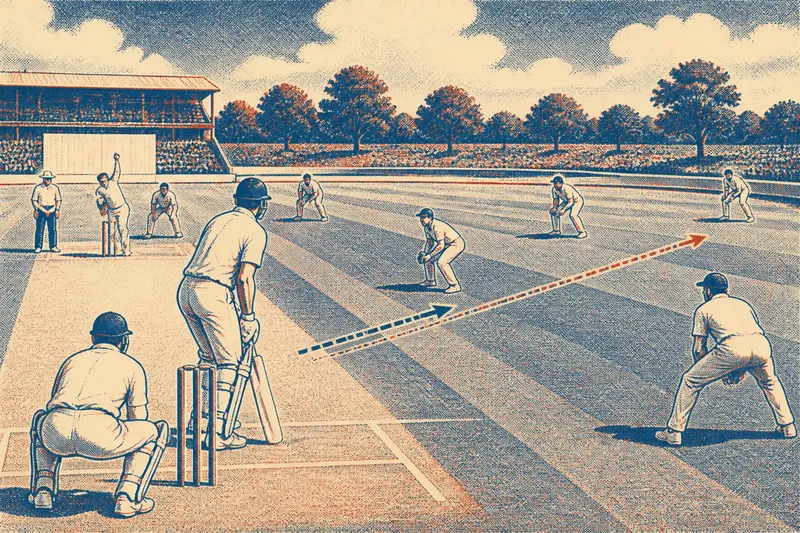
A batter settles at the crease, glances towards fine leg and sees a fielder standing deeper than before. That leg-side field changes the options available: a glance towards the boundary may now meet a hand, while a softer touch into an open pocket could bring a run. The arrangement is not simply defensive or attacking; it sets a choice between space, timing and risk.
Read the field as a map of scoring lines
The leg side is the half of the ground behind the batter’s legs as they face the bowler. It includes areas such as square leg, midwicket, fine leg and long leg. A fielder’s position matters because the batter usually plays a ball into a particular line rather than aiming at an abstract part of the field.
Start by noticing where the fielders are, then look for the gaps between them. A close square-leg fielder may make a controlled pull more difficult, while a vacant midwicket region can offer room for a well-timed clip. A boundary rider at deep square leg may turn a shot that would once have travelled into a boundary into a chance to take a single.
Distance matters alongside direction. A fielder close in can cut off a quick single or create pressure on a gentle push; one stationed near the boundary is more concerned with stopping a powerful shot. When watching, note both the fielder’s position and the kind of shot that could reach that patch of grass.
Notice what the captain is trying to protect
A captain arranges the leg-side field in response to the batter, bowler and match situation. Several fielders in the deep may be intended to limit boundaries from a pull or sweep. A tighter ring can instead challenge the batter to hit through a small gap or risk being caught close to the bat.
Every placement leaves something less protected. A captain who guards the square boundary may leave a softer scoring area behind square, while a fielder brought in to stop singles cannot also patrol the rope. The trade-off is the point: the field directs the batter towards a less comfortable option rather than shutting down every possible shot.
The bowler’s line helps explain the plan. If the ball is aimed at the batter’s body or leg stump, the captain may expect a glance, flick or pull. If the ball is outside off stump, the leg-side arrangement could be a secondary boundary defence, or a way to tempt a batter to move across the crease and manufacture a shot.
Use a simple routine while watching
Rather than trying to memorise every position, follow a short routine through an over. It helps connect the field to the delivery and the batter’s response, and it still works when the camera cuts away or the field changes after a wicket.
- Before the ball: identify the nearest leg-side fielder and the deepest one. Ask which likely shot each could stop.
- As the bowler runs in: notice the line and length, then consider which leg-side stroke is available without forcing the batter to move unusually.
- After contact: watch where the ball travels, not only whether it reaches the boundary. A fielder’s position may make a single the intended result.
- Between deliveries: check for a change in position. A captain may move a fielder after seeing the batter favour one scoring area.
- When the batter changes stance or moves across: reconsider the open spaces. The same fielder can guard a different shot once the batter alters their position.
Say you are watching a right-handed batter face a bowler delivering towards leg stump. A deep square-leg fielder is waiting near the boundary, but the space in front of square is open. If the batter turns the ball firmly towards deep square, the fielder may keep it to one run; if the batter uses softer hands to guide it into the open pocket, a quick single may be possible. The field has shaped the choice, but the batter’s timing and the ball’s placement still decide what happens.
Judge the batter’s options, not just the empty grass
An open patch is not automatically a safe target. The ball may arrive too quickly for the batter to place it there, or the required shot may expose the stumps and invite a mistimed hit. A gap is useful only if the batter can reach it with a balanced movement and suitable contact.
Likewise, a fielder can influence a shot without touching the ball. A close presence may make a batter hesitate over a glance, while a boundary rider can encourage a lower-risk push for one. The batter weighs the likely reward against the chance of losing a wicket, and that calculation shifts with the score, remaining time and partners at the crease.
It is not worth the effort to assign a fixed meaning to every named position or to treat a single delivery as proof of a captain’s plan. Fielders move, bowlers vary their line, and batters improvise. The more useful habit is to ask what the arrangement seems to invite or discourage on this particular ball.
How should you read a leg-side field?
What does a deep square-leg fielder usually protect?
A deep square-leg fielder is positioned to patrol the boundary in the region square of the batter on the leg side. The placement can reduce the chance of a pull or sweep reaching the rope, while leaving the captain to decide whether to protect nearby singles with another fielder.
Does an empty leg-side gap mean the batter should aim there?
Not necessarily. The batter also needs a delivery they can control and a shot that reaches the gap without undue risk; an empty area is only one part of the decision.
Why might a captain leave space near the boundary?
The captain may be protecting another likely scoring line, keeping a fielder close to stop singles, or inviting a shot that is difficult to time. The reason becomes clearer when you compare the field with the bowler’s line and the batter’s recent choices.
Can the same leg-side field suit different bowlers?
It can, but its purpose may change with the delivery. A bowler aiming at the body may use the field to challenge the pull, whereas one bowling wider may rely on it mainly to limit a batter who moves across the crease.
Keep the match picture in view
To read a leg-side field well, connect three things: the space left open, the delivery the bowler is trying to produce and the shot the batter can realistically play. Then watch whether the captain adjusts after the result. This way of reading the field makes each placement legible as a trade-off, rather than a collection of coloured dots around the boundary.
The next time you watch, choose one leg-side fielder and follow their influence for an over. Notice which shots they make less appealing, which space remains available and whether the batter changes approach. That small focus is often enough to see how the leg-side field changes a batter’s options without losing sight of the rest of the contest.