Keeping a First Cricket Scorecard: What to Notice Between Overs
A first cricket scorecard becomes easier when you track wickets, partnerships and changes in pressure, not every delivery. Learn what to record and why.
The scorer’s table is quiet until a wicket falls, then everyone wants to know the score. Keeping a first cricket scorecard need not mean writing down every ball: a few well-chosen notes can show how the contest shifts between overs.
This is a spectator’s record, not an official scorebook. Use it to follow the innings as it develops: where runs come from, what changes after a dismissal, and which side seems to have gained a little breathing room. Leave space for uncertainty; the aim is to understand the match, not to keep pace with every detail.
1. Set up a page that is easy to scan
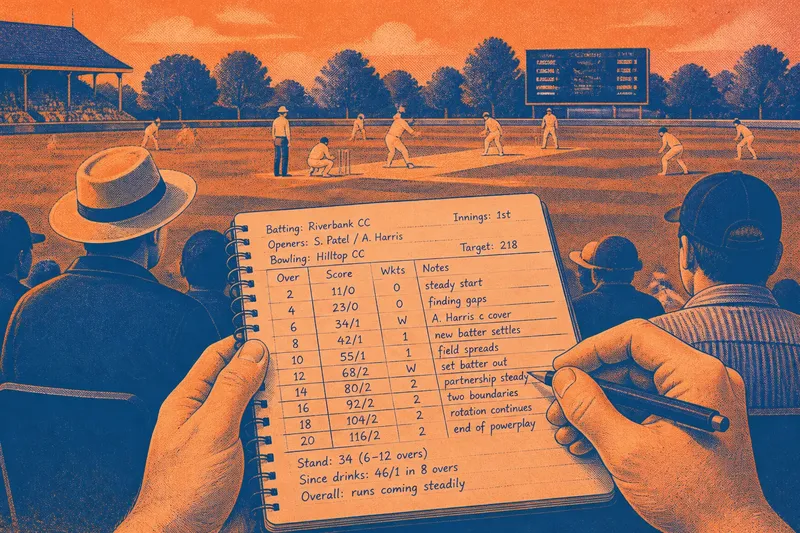
Draw a simple table before play begins. Give it columns for the over, the score, wickets lost and a short note about the moment. A notebook page works well; so does a printed scorecard with room in the margins. Keep the writing area generous enough for a phrase such as “new batter settles” or “field spreads”.
Write the batting side and innings at the top, along with the names of the two opening batters if you know them. Leave a line for the bowling side and, if it is available, the target. These details help make the notes intelligible later, especially if you return to the page after a break.
Do not try to imitate a scorer’s full notation unless you already understand it. A personal shorthand is fine: “4” for a boundary, “W” for a wicket and “2” for two completed runs are easy to read back. If a symbol could mean two things, spell it out instead.
2. Record the score at natural pauses
For this kind of card, note the total and wickets at the end of an over, or whenever the match has a natural pause. The score answers a basic question—how many runs have been made—while the wicket count gives context. A total that looks comfortable can feel precarious if several batters are already out.
Make each entry compact. “12 overs: 68/2” tells you more than a row of unconnected runs, because it ties the score to a point in the innings. If you miss a moment while watching the field or talking to someone, leave a blank and fill it only if the display or scorekeeper makes the answer clear.
Keep the scorecard’s purpose in mind. If the official board changes and you are unsure whether it includes a correction, use the displayed figure as a prompt rather than quietly inventing a missing detail. You can add “scoreboard” beside it, or simply mark the uncertain entry with a question mark.
3. Notice what the last over changed
At the end of an over, ask what is different from the start of it. Perhaps the batting side added runs without losing a wicket, a new bowler came on, or a batter began taking fewer risks. One short note is usually enough; a line of commentary about every ball will crowd out the pattern.
Separate what you saw from what you infer. “Two boundaries” is observable. “Bowler under pressure” is an interpretation, so phrase it as a tentative reading: “boundaries may change the plan”. That distinction makes the card more useful when the next over tells a different story.
Changes in the field can be worth noting when they are visible and relevant to the moment. “Deep fielder moves to the boundary” is more informative than “field changes”, because it records what happened without claiming to know the captain’s reason. The card is a record of the contest as you understood it from your seat.
4. Give wickets their own line of thought
A wicket is not just one less batter. It can bring in someone new, end a useful partnership and alter how the remaining players approach the innings. Mark the score and over when it falls, then add a brief note about what changes: “new batter in”, “set batter out” or “tail begins” if that description fits what you can see.
Be careful with dismissal descriptions. A catch, run-out, bowled dismissal or other method is worth recording only when you have seen it clearly or can read it on the board. Otherwise, write “wicket” and move on. Guessing can leave you with a confident-looking record that is less useful than an honest gap.
Also note who is at the crease after the wicket, if you can identify them. That can explain the next passage of play: a new batter may take time to settle, while the other batter may keep the score moving. Treat this as a possibility, not a rule about how any player must bat.
5. Follow partnerships rather than isolated boundaries
A boundary is vivid, but the partnership gives it company. Two batters may accumulate steadily through singles and twos; another pair may score in bursts. Jot down when a pair comes together and when it ends, if the information is clear. Their stand can help explain why the innings feels settled or suddenly vulnerable.
You do not need to calculate the partnership total. A note such as “steady stand, no wicket since the drinks break” is enough if you have been following the score. If a dismissal interrupts the stand, record the change and return your attention to the new pair.
It is not worth the effort to write down every single, dot ball or leave for a casual first card. Those details can matter in a formal scorebook, but here they often make the central shifts harder to see. Reserve space for moments that alter the shape of the innings.
6. Connect the target to the remaining contest
In a chase, the total alone does not tell you how close the batting side is to its task. Note the target if it is displayed, then record whether the required runs seem to be coming steadily or whether the gap is widening. You can describe the direction in plain language instead of calculating a rate.
For example, “target still distant; wickets falling” is a concise judgement if both parts are visible in the match. “Need a boundary every over” is a stronger claim and may depend on the format and remaining overs, so avoid it unless you have the figures to support it. A scorecard should help you follow the contest without pretending to be a prediction.
When the target is reached or the innings ends, write the result as it is announced or shown. If the match continues to a second innings, start a fresh section rather than squeezing the new score into the first side’s notes. Keeping the two innings separate makes the record easier to read.
7. What should a first cricket scorecard include?
Do I need to record every ball?
No. For a personal spectator’s card, over-end scores and a few turning moments are enough to follow the innings. Ball-by-ball notation is a different, more detailed task.
Which score should I write down?
Record the total and wickets lost, such as “68/2”. That pairing gives a clearer picture than the run total by itself.
What if I cannot identify a player?
Write “new batter” or note the shirt number if it is easy to see, then add the name later only if it becomes clear. Do not let an uncertain name interrupt your attention to the match.
Can I use my own symbols?
Yes, provided you can understand them afterwards. Add a small key at the top of the page if you use abbreviations beyond familiar marks such as “W” and “4”.
8. Try the method on one passage of play
Say you begin watching an innings when the board reads 41/1 after eight overs. You write that score at the top of your section, then add “new bowler” when the bowling change is announced. By the end of the next over, the board reads 49/1; you note “8 runs, no wicket” and, if you saw two boundaries, add those as the reason the over stood out.
Imagine the next over ends with a catch and the board changes to 53/2. You record the score, mark the wicket, and write “set batter out; new batter in”. The resulting card does not claim to explain the whole innings, but it makes the sequence legible: a productive over followed by a dismissal that may change the batting side’s approach.
Later, you can look back and ask whether the new pair restored a steady rhythm or whether the bowling side kept taking wickets. The answer comes from the next entries, not from a prediction made at the moment. That is the value of a small, readable record.
9. Keep the notes useful after the match
When play ends, add the innings result and any detail that helps you remember the contest, such as a partnership ending at a turning point or a chase tightening near the finish. Keep this note factual where possible. “The field spread after the boundaries” describes an observable change; “the field spread because the captain panicked” assigns a motive you may not know.
If you compare your card with the official score afterwards, treat any differences as a chance to learn the notation or spot where you lost track. There is no need to rewrite the page unless you want a clean record. A few imperfect notes can still preserve the sequence you watched.
A first cricket scorecard works best when it leaves room for watching. Start with the score, wickets and one change worth remembering; add detail only when it helps explain what happened next. Keep that simple habit, and your notes can make the next spell of play easier to read without turning the match into an accounting exercise.