From Village Green to Enclosed Ground: Cricket’s Playing Spaces
Cricket grounds shape how a match feels and is watched. Compare open greens and bounded venues to see how each organises play, spectators and shared space.
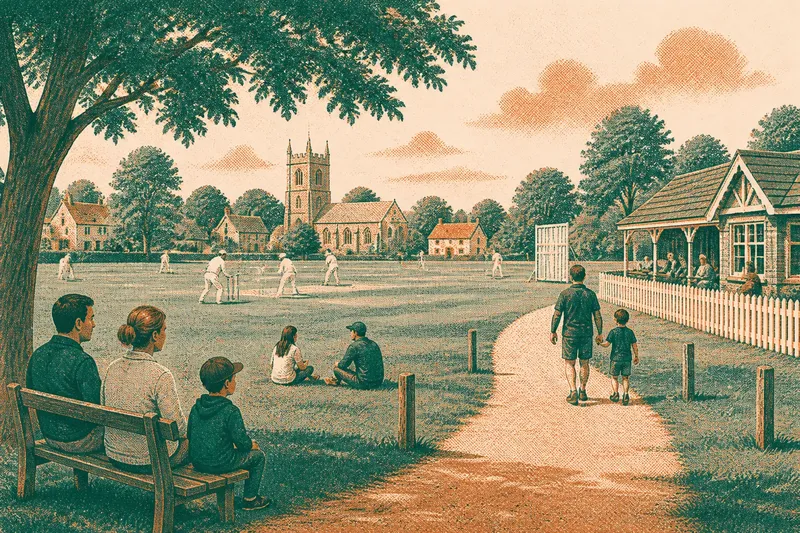
A fielder chasing a ball across a village green may need to skirt a footpath, a tree or a row of spectators. At an enclosed ground, a fence and marked boundary make the edge easier to read. Cricket grounds shape how a match is experienced, but neither open greens nor bounded venues are universally better.
Shared greens keep cricket close to local life
Some cricket matches have been played on land that served purposes beyond the game, such as village greens, commons or meadows. The details varied from place to place: not every early match used a shared green, and there was no single path from common land to club ground.
Where land was shared, cricket could sit alongside everyday local activity. People might pass along a nearby path or watch from the edge, and the ground could be used for other purposes at different times. That arrangement offered informality, while requiring the game to coexist with other users.
Local features could help define the playing area. A hedge, ditch, road or group of trees might affect where the boundary was set, making each ground distinctive. These features could also make the edge less obvious than a continuous fence or marked rope.
Bounded grounds make the playing space easier to read
Many established club grounds have recognisable features such as a perimeter fence, pavilion, sight screens or a prepared playing surface. These elements distinguish the cricket space from its surroundings, though a club ground need not be fully enclosed.
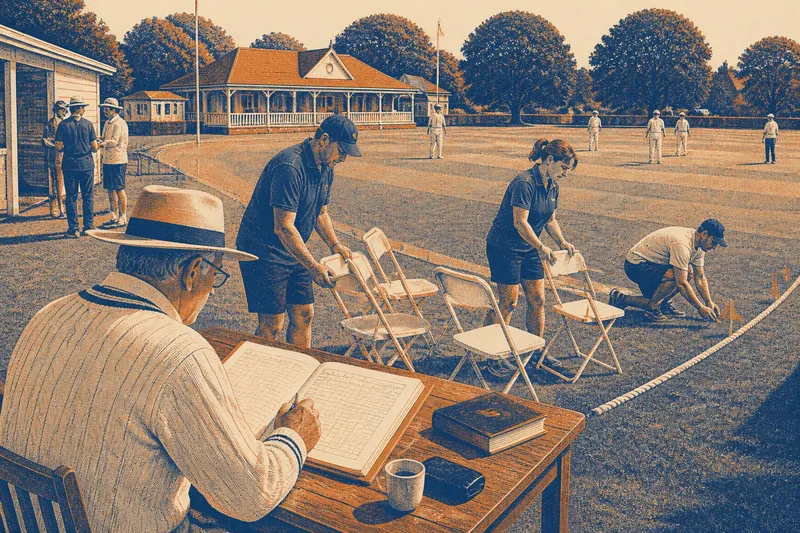
A clear boundary helps players, officials and spectators understand where the playing area ends. A pavilion gives teams a base apart from the viewing area, while entrances and seating can guide how people move around the venue. These arrangements can suit regular fixtures without making every ground feel like a major venue.
Enclosure also changes how a ground relates to its neighbours. A fence may separate play from a road or another use of the land; planned entrances can make access more directed. The resulting venue may feel more organised, but less like an open part of the village.
Different ground types suit different uses
A shared green supports informal play
An open green can suit informal games and gatherings where an easy connection with the surrounding community matters. Its shared use may welcome passers-by, but it can be less practical when a match needs a clearly controlled perimeter or distinct areas for players and spectators.
A defined club ground balances access and organisation
A club ground with a rope, fence or other recognisable edge offers a middle course. It can retain a local feel while giving teams and spectators a clearer sense of where the match takes place. This arrangement can suit regular fixtures that need a stable setting without a wholly enclosed venue.
An enclosed venue supports planned facilities
A more enclosed venue can suit organised competition or an occasion that calls for a pavilion, changing areas or planned spectator spaces. Its layout can make the playing area and viewing positions easier to understand. Access and use may be more controlled than on a shared green.
Say a village club is choosing between a shared green and its bounded club ground for a friendly match. The invented starting point is a fixture intended to welcome neighbours, with no need for separate team facilities; choosing the green would leave the game visibly connected to village life, though players and spectators would share space with other local users. If the club instead expects a busy fixture and needs distinct places for teams and viewers, the bounded ground would make those areas easier to organise, at the cost of a less open feel.
Ground edges shape the experience of watching
On an open green, spectators may gather along a path or under trees, with cricket unfolding among other local activity. The view can feel close and informal, though people may need to move to keep sight of play. A boundary that blends into the landscape can also make a ball’s position harder to judge.
At a bounded ground, the perimeter can organise where people stand and how they move. A pavilion or seating area gives spectators a recognisable meeting point, while a fence helps define the playing space. A neatly arranged venue may feel more like a destination than a shared patch of land.
The surrounding landscape matters too. A green may open onto houses, a churchyard or a village street; an enclosed ground may frame the view with trees or club buildings. Those surroundings contribute to the character of a match without determining which type of ground is better.
What should you look for in a cricket ground?
How does a shared green differ from a cricket ground?
A shared green is land that may serve local purposes as well as cricket. A cricket ground has a recognised playing area, whether or not a fence marks its perimeter.
Does an enclosed ground change the laws of cricket?
No: a venue’s layout does not itself change the laws. Its boundaries and surroundings do shape the practical setting, including how clearly players and spectators can identify the playing area.
Which kind of ground suits a community club?
It depends on whether open access, regular organised fixtures or dedicated facilities matter most. A shared green can suit an informal public atmosphere, while a bounded club ground can combine a local feel with a more defined venue.
Why do boundaries and pavilions matter?
A boundary makes the edge of the playing space easier to recognise, and a pavilion can provide a base for teams or a social meeting point. Their value depends on how the ground is used; neither feature is essential to every match.
Choose a setting by how people will use it
Start with the activities and people the venue needs to accommodate. Consider whether cricket will share the land with everyday local use, where spectators can gather and whether teams need a distinct base. Then look at the site’s natural features: trees, paths, neighbouring buildings and open approaches may add character or complicate movement.
- Check whether other local activities use the same land; if shared access is a priority, favour a green or an arrangement that leaves those uses open, otherwise consider a more defined venue.
- Check whether the playing edge is easy to recognise; if it is unclear to players or spectators, consider a rope or other visible boundary, otherwise retain the existing edge.
- Check whether spectators can watch without obstructing paths or play; if they cannot, choose a layout with clearer viewing areas, otherwise keep the informal gathering arrangement.
- Check whether teams need a separate base; if they do, consider a pavilion or suitable club facilities, otherwise avoid adding a building solely for appearance.
- Check whether a road or neighbouring activity lies close to the playing area; if the setting creates a conflict, consider a clearer separation or another layout, otherwise keep the more open edge.
- Check whether entrances make access straightforward for intended users; if they do not, consider a more legible approach, otherwise keep access simple rather than adding unnecessary barriers.
It is not worth making every ground look alike. A fence, pavilion or formal boundary can be useful, but adding features simply to imitate a larger venue may weaken the qualities that make a local space distinctive.
For anyone comparing cricket grounds, the useful question is how each setting supports the people who play, watch and use the land. That perspective makes room for the welcoming openness of a green and the clearer organisation of an enclosed venue, without treating either as the final stage of a universal historical progression.